Reflection of ‘Trapped.’
The AS Foundation Production brief was to
produce a film opening including titles, with duration of no more than two
minutes long, and my film opening is a horror/thriller.
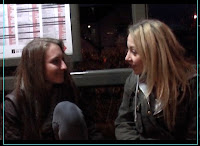 The first shot I used in ‘Trapped,’ was a
two shot of the main character and her friend. I used this so that the audience
can focus on the two characters in the shot, and to allow them to follow the
conversation.
The first shot I used in ‘Trapped,’ was a
two shot of the main character and her friend. I used this so that the audience
can focus on the two characters in the shot, and to allow them to follow the
conversation. The next few shots I used, were medium close ups of the main
character. The reason I used this
shot is because the audience can then focus on the main character, and it keeps
their attention on her, so that they can focus on what is happening. Then I
used three panning shots of the main character walking away from the bus stop
and walking home. The purpose of these three shots was to allow the audience to
see the movement of the main character walking. The next shot I used was a full
shot of the main character lying down on a bed. The reason I used this was to
show the audience the character’s entire body lying down on the bed, and also
to emphasise the fact that she is unconscious. Afterwards there is a lot of
panning of the camera, when the girl wakes up. This makes the audience feel on
edge and makes them feel alarmed, as the girl is panicking and horrified. Next
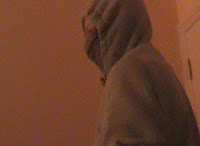
I used a mid shot of the abductor, who the girl came across when she was
walking home. The reason I used a mid shot, was because a close up would be too
near to the character’s face, but I did want the audience to see the unknown
character’s face especially the balaclava they were wearing.
Lastly I used a
mid- shot of the girl lying down again unconscious. I did this, so that the
audience would then wonder what had happened to her. Then I zoomed into her
face, so that the shot went from a mid shot to a close up. This builds tension
for the audience, and makes them question what would happen next.
 Q:
What kind of media institutions might distribute your media product and why?
Q:
What kind of media institutions might distribute your media product and why?
The media institution in which I think
would distribute my media product is the Film Industry, as my film will be
released in cinemas for people to watch, and when it is released it will come
out on DVD and on public television. The distributer of my film is Lionsgate or Lions Gate Entertainment Corporation, which is
a North American entertainment company. As of
2012, it is the most commercially successful independent film and television
Distribution Company in North America and the third most profitable movie
studio. The
reason I chose Lionsgate is because it produces and distributes films of
similar or the same genre as mine. Some of these include films such as all of
the Saw films, and the Hostel films.
Q:
Who would be the audience for your media product?
The audience of my media product would be
teenagers and young adults mainly, however middle-aged adults would watch this
short film as well. This film is aimed at fans of murder mysteries and horror
films, and they are the type of people to watch late night horror movies, in
hope to be scared. I attracted the audience by the sound, as the music at the
end of the extract is very eerie and frightening. Furthermore by the use of
darkness when filming outdoors, which was most of the extract. Finally the use
of certain shots, such as when the girl is put back to sleep at the end of the
extract, which is where a close up is used of her neutral face, and the camera
then zooms in further.
Q:
How did you attract/address your audience?
I researched title sequences and film
openings, using a website called ‘Art of the Title.’ This has a variety of
famous film openings of different genres, such as Horror, Comedy, Thriller etc.
The film openings include the titles such as A Film4 Production and Directed
by. As my short film is a horror/ thriller, I watched film openings from famous
films of this genre, such as Alien, Dawn Of The Dead, Halloween and Psycho.
These film openings were extremely helpful, as it presented titles that I could
use in my film opening. Furthermore it helped me to decide which type of music
or sound I could use in my opening, and it helped me to think about which types
of shots and scenes would be most effective upon the audience.
Q:
In what was does your media product use, develop or challenge forms and
conventions of real media products?
My media product uses forms and conventions
of the opening of a movie as the order of the titles in my film opening,
reflects the hierarchy. For example the first couple of titles are Lionsgate
Presents and A Film4 Production. Afterwards the next few titles are things like
Costume Design by, Screenplay by, Music by etc. Finally the last titles are the
people that star in the film, which in my case are the three characters, which
are introduced in the opening of my film, followed by Directed by and Produced
by. Even though the titles reflect a hierarchy, the two main titles are at the
end, as they are significant and fit better at the end of the film opening. Secondly
the film opening introduces the setting, which for my film is a cold wintry
night at a bus stop. The mood is also introduced, which in this case is
chilling, dark and quite gothic, as it is a cold night. Furthermore the
characters are introduced, and as it is a film opening, they are unknown and the
audience is just getting to know who they are and who is who. My main character
is the one character, which the audience will focus on the most. The friend of
my main character does not play a big role in the opening, as she is only at
the very beginning for about thirty seconds. The abductor is the third
character in the opening and is unidentified.
Q:
How does your media product represent particular social groups?
My short film represents a particular
social group of working class to middle class people. This is represented when
two of the characters are waiting at a bus stop, so they are typical Southern
English teenagers. The working class people are more likely to take the bus
whereas the middle class are more likely to take a car. While they are sitting
at the bus stop, they are talking about a party that they were just at. This
shows a representation of teenagers as party types, which is stereotypical. The
main character is female, and a representation of females in my film opening is
given off as being very vulnerable and helpless. This is shown when the girl is
abducted by a stranger, also representing females as victims. Moreover a film
similar to this could be Taken with Liam Neeson in, with a similar storyline,
this shows that it is a common construct in thriller/ horror films.
I created a questionnaire for people to
fill out and give me feedback on my film opening. I asked four people to do the
questionnaire including six questions which were: Which parts of Trapped did
you like most and why? What genre does Trapped fit the most and why? Does the
sound fit what is happening in Trapped and how? In which ways does Trapped look
like the opening of a film? Who do you think would be the target audience and
what kind of TV programmes would they watch? Finally, what improvements would
you make to Trapped? For the first question most people said they liked the
part where the main character was walking home and the abductor comes into the
scene, reasons being that it gives a scary vibe, the fact that the shot was set
out well and because it was well acted. Also they said they liked the bus stop
scene as it is authentic and they were left wondering with what is going to
happen next. For the second question most people said that it was either a
horror/ thriller or a horror/ drama, as it has a lot of scenes containing
tension, suspense and the sound at the end made them think this. For the third
question most people said that the sound was eerie and increases the tension,
however one person said that the dialogue was overpowered by using unnecessary
outdoor locations. For the fourth question people said that they thought this
because of the introduction of unknown characters and the titles appearing on
screen. For the fifth question most people said that they think the kind of
people that would like this film would watch things like Horror programmes,
murder mysteries and TV dramas, and that it would mostly be aimed at Young
adults and teenagers. Finally for the sixth question people said that the
improvements they would make to this film opening would be the dialogue at the
beginning, use of lights and possibly background music in some of the scenes.
Q:
What have you learnt about technologies from the process of constructing this
product?
I have learnt about certain technologies
from the process of constructing this product. For example when I was doing my
Continuity Exercise and my Life on Mars exercise, which was being shown a clip
from the programme ‘Life On Mars,’ and we were given the sound used in that
clip and film what was happening in the extract, using the same shots, we had
to use Final Cut Express to edit these pieces, and we did not know how to use
it, as we had never used it before. Then afterwards we started our film
openings where we used Final Cut Express again. Furthermore for the music that
we wanted to put into our film openings, we learnt to use GarageBand to select
the appropriate music, and once found a decent piece we would send it to iTunes
and get it up on Final Cut Express. Lastly we had never used titles on the
previous exercises, but we had to have them on our film openings, so we learnt
how to put them on using Final Cut Express.
Q:
Looking back at your preliminary task, what do you feel you have learnt in the
progression from it to the full product?
Looking back at my preliminary task, I feel
I have learnt a lot in the progression from my film opening to the full
product. Firstly I have learnt about transitions and how to use them, e.g.
fade-ins and fade-outs. Even though I did not use many transitions, I feel as
if I know how to put them on when editing. Secondly I have learnt to use
programmes such as Final Cut Express and GarageBand. Additionally I have learnt
the impact that editing and sound has upon an audience, as it can change the
mood of the atmosphere. Finally we had to convey a more complex meaning in our
film openings, whereas in the continuity exercise, it was more simple as
someone just had to walk through a door and talk to a person using shot-reverse-shot.


